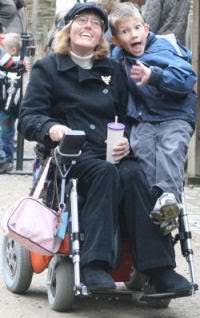
Now that I’m blogging, I thought you all should know who the blogger is. This is me in a nutshell:
On July 20, 1964, in the middle of a very hot summer, I came into this world kicking and screaming. This might sound like the average birth to you but it was not. After nine months of a healthy pregnancy, I was born anything but healthy. My umbilical cord was wrapped three times around my neck and it was getting harder and harder to breathe. After unraveling me, I was placed in an incubator and a priest gave me my last rights. Little did everyone know then that I was to defy everyone and every negative thought they had.
Five days after delivery my mom was released while I was still under observation. As the doctors and nurses watched me, they called me a “fighter“ but didn’t know there was something just not quite with this newborn. Two weeks after my birth, I was released to my proud parents and thirteen-year old sister Ursula. The first big event in my life – my baptism was different. I was the only baby who could not have the oil or water.
At four months, I was having great difficulty sitting up and keeping my head upright. To my mom this didn’t seem right. She had my sister to compare me to and I was in no way like her. My parents talked to people they knew concerning a baby’s development stages. They told her to wait two or three more months before consulting a doctor - development takes time and every baby is different.
Three months came and went. I was now seven months, but there was still no change. My mom was sure something definitely was wrong, but my dad could and would not accept this. To him his little girl was perfect. Even the pediatrician saw nothing unusual, excusing my behavior as being a “slow” child needing more time to develop. It was when my mom noticed that I had become cross-eyed and was referred to an optometrist. This doctor confirmed her doubts and referred us to a New York hospital specializing child development. The very next day I was being examined there and diagnosed as having Cerebral Palsy. This medical phrase was completely foreign to my parents. The doctor assured them this condition was not fatal and told them it is a malfunction of a small part of the brain that controls the various muscles in the body. This damage was from the umbilical cord being around my neck. Not enough oxygen entered that part of the brain. The cerebrum area of the brain, which is the center of the thought and intelligence, was undamaged. Under his advisement, I was enrolled in a specialized school where children like myself were receiving the proper care and attention.
I attended the United Cerebral Palsy Center’s infant program in Jamaica, Queens. There I was taught how to properly sit, stand, speak, and the other fundamentals of child development. Through vigorous physical therapy, I learned to coordinate my leg and arm muscles. In the very beginning, I sat in a wheelchair, because I could not maintain my balance at all. As the years went along, I graduated to walkers, canes and crutches.
Although I was getting therapy at the center, this was not enough and therefore I needed to go to the hospital in Manhattan for extensive rehabilitation. Mondays – speech therapy, Wednesdays – physical therapy and Fridays – occupational therapy. This was not only going to be a challenge for me, but for my mom as well. Being an immigrant from Germany, living in a city where everything was within walking distance, she had no driver’s license. Through a friend, she quickly learned and got her license on the second try. This was half the battle; she also needed someone to go into Manhattan with us. I could not sit in a chair let alone in a moving vehicle without my head bouncing all over the place. The same friend volunteered.
Summers meant vacation from school but not from therapy so the center sent a visiting nurse to continue poking, pulling and prodding me. We lived on the second floor of a three-family house. When the downstairs doorbell rang, I’d crawl to the top of the stairs and yell down, “When are you going home?” My mom would remind me she hardly had a chance to come through the door. Nonetheless, I wanted to know!
From age five to eight, I appeared on several United Cerebral Palsy telethons as a representative for my school. On one such occasion, they did a segment on me throwing away my crutches completely. I have been walking without them ever since. This new found independence was a fun time in my life because my dad who held my hand everywhere I went, had to get used to letting me walk to where I was going on my own. I’d get up and he’d be there with his hand out and I’d laugh saying, “I can do it!” From there on I believed I could do anything! I had a setback when I could not walk because of a broken leg. I did this while riding a trike. A friend was helping me ride by standing on the back and pushed. I felt we were going too fast and decided to put my left foot in the front wheel to stop. We did, but boy was I in pain!
I had as many friends as anyone else but the teachers and counselors at the center thought it would be a great help if I were to spend time away from my parents. Not only did I need to learn to become independent, but my parents deserved a break also. I was not looking forward to this summer at all. Along with my best friend, Eva Munson, I went to my first sleep away camp for disabled kids. We were not allowed visitors and I stayed for the six-week program while Eva went home after three. There I learned to dress and feed myself. I hated it! I was so homesick! I begged to go home and although I got letters with gum in them every other day, I was not a happy camper! I spent two summers there before the sponsored organization depleted its operation funds. You should have seen me run down the driveway when my dad came home from work the day camp was over! I ran saying, “Daddy, daddy.”
This was not my first camp experience. I went to a day camp that my father built with Eva’s father. It was funded and ran by United Cerebral Palsy of Queens. You see, while my mom was getting me to therapy, my dad was getting a form of therapy of his own. He just couldn’t talk about what was going on with people so he decided to join the father’s support group at the center. There, they not only talked but were given jobs to get them involved with the center. Fred and my dad started out running bingo night and then constructed a house down the street that would house the camp.
I wound up having a great camping experience in New Jersey. At Camp Oakhurst the personnel taught campers such activities as arts and crafts, drama, music, woodworking and photography. I liked it so much I kept returning for fourteen years. They would have let me continue coming for their adult program, but my parents decided I was too old.
In my first year of junior high school I was one of those well-known, well-liked students. By the end of my second year I was fully mainstreamed. In the school’s mainstreaming program, the disabled pupil is placed into classes having as many as forty “non-handicapped” students for the entire school day. I thought this experience was not only very beneficial to me, but to my teachers and classmates as well. Many of the students had never before come in contact with a disabled person. As a result, they would often ask if I was either drunk or stoned; some would just stare or laugh. Since I was able to laugh at myself, I was able to put them at ease. This worked most of the time and my fellow classmates started to ask questions out of pure curiosity and wondered what it was like to be handicapped in a classroom setting, among other things. I understood their curiosity and tried to answer them as openly and honestly as I could. I actually started to enjoy teaching everyone in school about my disability. Sometimes though, it would get very frustrating because deep down I had the feeling knew that no matter how much or how long I talked to them, they would never fully realize what it is to be looked upon as different.
At age of sixteen I went to Francis Lewis High School. Better known as one of the toughest schools in Queens. Since I don’t have the physical ability to write, my notes were taken for me. A teacher, who taught publishing, didn’t want me taking his class because I couldn’t write. When I sat in the seat in front of his desk and I said, “my disability is physical not mental”, he got the idea I wasn’t leaving and I wanted to be a writer very badly.
In 1987 I graduated college with a BA in English. Unfortunately, there was no work in the field where we were living so I stumbled (excuse the pun) into a job with the Nassau County Police Department. I worked there full-time as an inventory custodian.
For most of my spare time, I was heavily involved in sports; wheelchair handball, track and field, equestrian, and trike: all for competitions. In 1994, I went to international competition for trike and bought home a silver medal.
Like I said, I am a person who defies what people say.
I was told me I would never wear "regular" shoes and be able to walk in them - I do!
I was told I could never drive a car - I did as well as ride a horse!
I was told I would never marry because no one other than my parents would want to care for me - I married in 1999.
I was given a dog from people who said I would never have a child - I have a wonderful son!
Life is good!